Marine Vessels

involved in the transportation of weapons, stolen Ukrainian products and in the circumvention of sanctions
Total number:
1404
Marine vessels
534
Masters
Updated: 07.05.2026


Total: 1404
YANTAR
Vessel name
YANTAR
IMO
7524419
Flag (Current)
russian federation russian federation
Vessel Type
Research Vessel
Category
Other
icon arrow-tree Involvement in energy projects
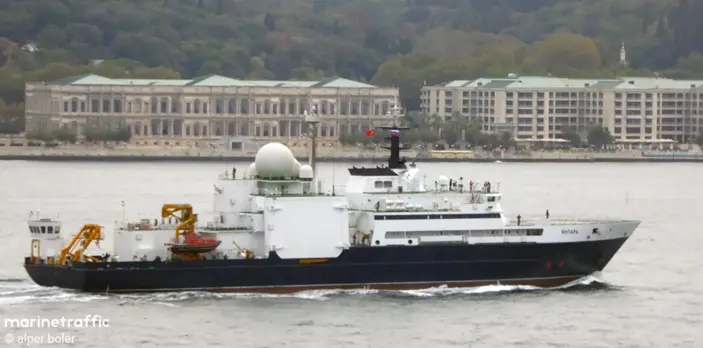
The russian oceanographic research vessel, the lead ship of Project 22010 "Kryus," is nominally designed to study the thickness of the World Ocean and its bottom, belongs to and is operated by JSC Yuzhmorgeologiya, one of the leading scientific and production divisions of JSC Rosgeologia, which has more than 65 years of practical experience in conducting marine and land geological exploration work.
The vessel was built at the Baltic Shipyard (Kaliningrad) by order of the Main Directorate for Deep Sea Research, a secret division of the russian Ministry of Defense.
In fact, the vessel is operated under the supervision of the Main Directorate for Deep Sea Research of the russian Ministry of Defense.
The Main Directorate for Deep Sea Research (military unit No. 45707) plans and carries out special secret missions, including:
- deep-sea research of the seabed,
- reconnaissance of underwater global infrastructure,
- installation of various equipment on the seabed,
- collection and recovery of debris, equipment from sunken sea and air vessels, satellites to obtain information about the level of technological development of potential adversaries,
- study of human physiology in extreme underwater conditions,
- conducting rescue operations.
It is considered that the Main Directorate for Deep Sea Research plans and controls deep sea sabotage and reconnaissance missions in the interests of the russian federation.
The hydrographers of this military unit are engaged not only in reconnaissance activities, but also in planning and preliminary preparation of large-scale sabotage operations on transatlantic fiber-optic communication lines between Europe and North America.
The ship can carry helicopters on board and is equipped with special underwater vehicles that can dive to a depth of about 6,000 meters. It is equipped with information gathering equipment and can carry manned and unmanned deep-sea submarines. The ship is likely capable of intercepting military communications and internet cables and installing explosives that can be detonated in the future.
The ship can be used for reconnaissance and sabotage against the underwater infrastructure of NATO and EU member states, especially in the Baltic, Barents, and North Seas.
The vessel is believed to be part of a flotilla of russian vessels that participated in a 13-month campaign to monitor the underwater infrastructure of NATO and EU member states, which began in the fall of 2023, particularly in the Irish Sea between the UK and Ireland, and along submarine cables between mainland Norway and the Svalbard archipelago, among other locations.
Vessels and ships associated with the Main Directorate for Deep Sea Research are based in Gadzhiyevo, a strategically important location in the Kola Bay of the Barents Sea.
Today, russia maintains a fleet of research vessels that serve civilian, research, and military purposes and are considered a key element of russian naval strategy, especially in the field of deep-sea exploration and sabotage. The russian fleet retains significant experience and specialized capabilities for underwater operations, supported by a special department for deep-sea sabotage and reconnaissance.
View profile
YURI OSOKIN
Vessel name
YURI OSOKIN
IMO
9912701
Flag (Current)
russian federation russian federation
Vessel Type
Research Vessel
Category
Other
icon arrow-tree Involvement in energy projects
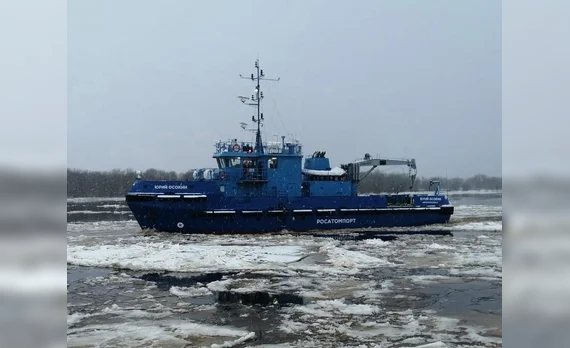
The hydrographic vessel is the second vessel of the E35.G project, built at the Balakovsky repair and shipbuilding shipyard (Saratov region) commissioned by FKU "Directorate of the State Customer" for FSUE "Hydrographic Enterprise" (part of the Rosatom State Corporation).
The E35.G project vessels were developed as part of the federal project "Northern Sea Route" and are designed to conduct hydrographic research and work in marine and coastal areas, in river estuaries, including in the Arctic basin of the russian federation during the summer-autumn navigation period.
The vessel is equipped with a multibeam echo sounder, which allows it to conduct research at depths of up to 400 meters.
It is stated that the vessel is intended for hydrographic research and other work in the Arctic zone of the russian federation (taking measurements on the Yenisei River, as well as in the Ob Bay of the Kara Sea).
The port of registry is Arkhangelsk.
The ship's displacement is about 260 tons. The ship is 33.5 m long and 8 m wide. The ship can reach speeds of up to 12 knots. The crew consists of 7 people, with 6 special personnel.
The vessel calls at the port of the sanctioned Arctic LNG-2 project.
The vessel belongs to the russian sanctioned FSUE Hydrographic Enterprise, which is part of the Rosatom state corporation.
FSUE Hydrographic Enterprise is the owner and operator of one of the largest dredging fleets in russia, and the single organization in russia that creates and provides navigation information to mainly large-tonnage oil and LNG tankers in the northern sea route regarding the most difficult areas and routes in terms of navigation. FSUE Hydrographic Enterprise has provided dredging services for a number of major energy projects in russia.
View profile
ALEXANDR DEEV
Vessel name
ALEXANDR DEEV
IMO
9940186
Flag (Current)
russian federation russian federation
Vessel Type
Passenger / Ro-Ro Cargo Ship
Category
Other
icon arrow-tree Link to a sanctioned entity
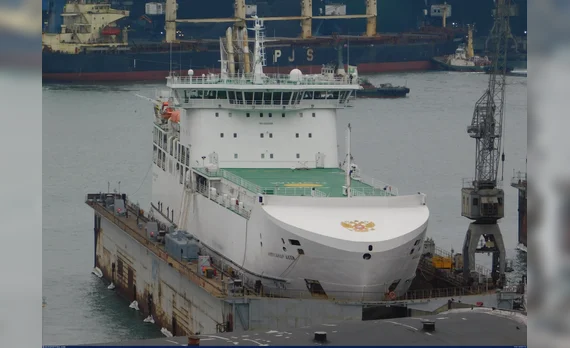
The cargo-passenger ferry, built according to the CNF11CPD project of the Vympel Design Bureau by the vesselbuilders of the Amur vesselyard (part of the russian state vesselbuilding holding company United vesselbuilding Corporation), is registered in the russian international register of vessels. It operates on the Vanino - Kholmsk line. The high ice class Arc5 allows the vessel to operate on the line all year round. It can carry 32 railway cars and 12 trucks, as well as up to 200 passengers.
The vessel belongs to the sanctioned russian state company JSC GTLK, controlled by the ministry of transport of the russian federation, specializing in air, sea, rail, passenger transportation, automobile, special equipment for russian companies in the transport industry, investment activities for the development of the transport infrastructure of the russian federation. JSC GTLK is the largest transport leasing company in russia, part of the russian transport network through the leasing of railcars, vessels and aircraft on favorable terms to support russia's development strategy.
The CEO of JSC GTLK is a sanctioned Ditrikh Yevgeniy Ivanovich.
In April 2023, USA imposed sanctions on vessels, including "Alexander Deev", associated with sanctioned persons Ditrikh Yevgeniy Ivanovich and JSC GTLK.
The vessel's safety manager is the russian company JSC SakhPasFlot.
View profile
To top