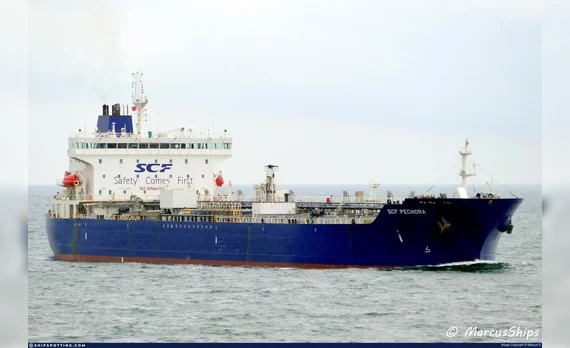
During the period of the oil embargo and the G7+ countries’ price cap policy on russian crude oil and petroleum products, the tanker was involved in the export of russian petroleum products from the ports of Ust-Luga, Primorsk, Saint Petersburg, Novorossiysk, and Taman to Turkey, Brazil, and the UAE.
The vessel through Sun Ship Management, Oil Tankers Scf Mgmt FZCO, is affiliated with the sanctioned PJSC Sovcomflot - the largest state-owned shipping company in russia for the maintenance and provision of marine hydrocarbon production, transportation of russian oil, petroleum products, liquefied gas. The main charterers of Sovcomflot vessels are the largest oil and gas companies and traders of russia. Sovcomflot participates in the maintenance of large oil and gas projects in russia: Sakhalin-1, Sakhalin-2, Varandey, Pryrazlomne, Noviy Port, Yamal LNG and others.
In July 2024, the United Kingdom imposed sanctions on a vessel for its involvement in the transport of russian crude oil and/or petroleum products from the russian federation to third countries.
Since December 17, 2024, the EU has imposed sanctions on the tanker for transporting crude oil or petroleum products originating in or exported from russia, engaging in irregular and high-risk shipping practices, as specified in International Maritime Organization General Assembly Resolution A.1192(33).
On December 23, 2024, Switzerland imposed sanctions on the vessel.
On February 21, 2025, Canada imposed sanctions on the vessel.
On June 19, 2025, New Zealand imposed sanctions on the vessel.
On December 4, 2025, Australia imposed sanctions on the tanker.
As of December 13, 2025, Ukraine imposed sanctions on the vessel.
On February 21, 2026, Ukraine imposed sanctions on the vessel’s captain.
Additionally, during the fuel crisis in the russian federation, the tanker is involved in the supply chain delivering gasoline from the Vadinar Refinery (Nayara Energy) to the aggressor country; 49.13% of the refinery is controlled by the russian sanctioned company PJSC Oil Company "Rosneft". Specifically, in late July 2026, the tanker IMO 93334245, through a ship-to-ship transfer operation in the Damietta area (Egypt), transferred to the tanker IMO 9292060 (sanctions imposed by the U.S., EU, Switzerland, the U.K., Ukraine, and Canada) nearly 36,600 metric tons of gasoline, which then delivered the cargo to the Vitino terminal (Port of Kandalaksha). The tanker IMO 9333424, in turn, was loaded with gasoline from the Vadinar Refinery on July 12, 2026.