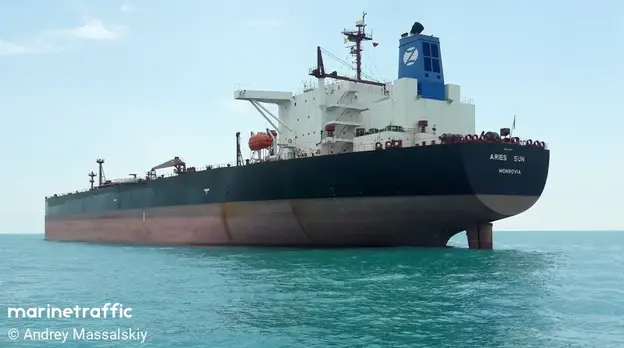
In 2024, the tanker is involved in the export of russian oil to China from the russian ports of the Pacific region Kozmino and Nakhodka.
The international non-governmental organization Greenpeace refers to the tanker as a shadowy fleet of tankers that transport russian oil around the world and threaten the environment.
According to Lloyd's List, the tanker is linked to anonymous Chinese buyers who spent about $376 million to purchase 13 tankers to carry out risky ship-to-ship transportation of russian oil in the middle of the Atlantic Ocean. Ship-to-shore logistics hubs are a common feature of the scheme, allowing for the concealment of ownership and origin of cargo. In addition to the mid-Atlantic STS hub, there are also areas near the ports of Kalamata (Greece), Malta, Ceuta, and the Caucasus where ship-to-ship operations have been established for russian oil. STS's operations in the middle of the Atlantic Ocean are outside the jurisdiction of port authorities, with limited technical and operational oversight, which increases safety and environmental concerns due to the unknown insurance and vessel ownership data.
Lloyd's List has tracked five Aframax tankers, seven large oil carriers and one Suezmax vessel to an anonymous buyer through separate but related companies operating offshore Hong Kong and China that own similar vessels. The group of tankers was acquired between May and July 2022 for a total of $285 million, based on ship brokerage reports and market valuations. Since then, all but one of the tankers have been involved in the transshipment of russian oil cargoes at a high-risk transshipment hub located 860 nautical miles west of Portugal in international waters. The vessels purchased by the anonymous Chinese buyer are 15 years old or more, making it impossible for most major oil companies to charter them and impossible to obtain conventional financing.
Under the sanctions, russia has begun to build up its own shadow fleet of outdated tankers, which has no 'ties' with the G7 and the EU and can transport oil in violation of price caps. russia disguises its shadow activities at sea under the 'convenient' flags of third countries, operates at sea without proper insurance from the international club of insurers, uses complex schemes to conceal the owners of the shadow fleet, uses various deceptive tactics to conceal the origin of its cargo, creates threats to environmental safety with large-scale economic costs for coastal countries due to the growing threat of oil spills, does not use pilots to navigate difficult areas, etc.
russia's 'shadow fleet' continues to provide multibillion-dollar revenues for the kremlin bypassing sanctions, disguising its activities under the flags of third countries, using complex schemes to conceal owners, and poses significant environmental threats with significant economic costs to coastal countries and/or the international community due to the outdated and inadequate insurance of shadow fleet tankers.
On November 25, 2024, United Kingdom imposed sanctions on a tanker in connection with the transportation of russian oil/oil products from the russian federation to a third country as part of the restrictions on the russian shadow fleet.
On December 16, 2024, EU imposed sanctions on the tanker (effective from December 17, 2024) due to the transportation of crude oil or petroleum products originating in or exported from russia, using irregular high-risk shipping practices as set out in the International Maritime Organization General Assembly Resolution A.1192(33).
On December 23, 2024, Switzerland imposed sanctions on the vessel in connection with the transportation of crude oil or petroleum products originating in or exported from russia, using irregular and risky shipping practices, as set out in the resolution of the General Assembly of the International Maritime Organization A.1192(33).
On January 10, 2025, USA imposed sanctions on a vessel considered to be part of the shadow fleet.
On February 21, 2025, Canada imposed sanctions on the vessel.
Since December 13, 2025, Ukraine has imposed sanctions on the vessel.
On February 21, 2026, Ukraine imposed sanctions on the master of the vessel.
On October 2, 2026, Japan imposed sanctions on the vessel.