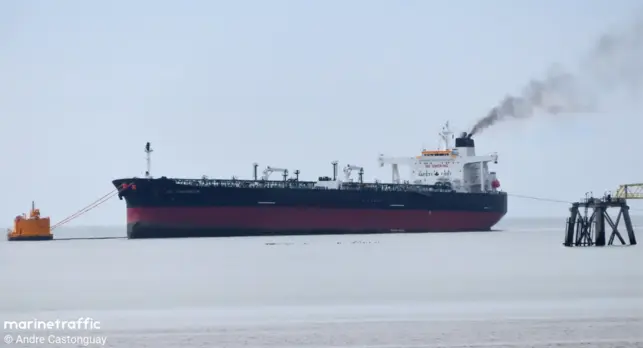
The tanker is involved in the export of russian oil from russian ports in the Black Sea, Baltic Sea, and Pacific region to third countries, as well as to the EU countries in violation of the G7 and EU oil embargo on russian oil. In particular, in December 2023, the vessel transported russian oil from the port of Novorossiysk ( russia) to the EU countries through a transshipment in the Lakonikos Bay.
The international public organization Greenpeace refers to the tanker as a shadowy fleet of tankers transporting russian oil around the world and threatening the environment.
The tanker is affiliated with the Indian company Gatik Ship Management, one of the leading operators of the so-called 'shadow' fleet involved in the transportation of russian crude oil under western sanctions, and the company Galena Ship Management, which is affiliated with Gatik, which in 2023, together with Caishan Ship Management, Gaurik Ship Management, Plutos Ship Management, Geras Ship Management, Girik Ship Management, Orion Ship Management, Nautilus Shipping, Ark Seakonnect Shipmanagement, Zidan Ship Management, was involved in a scheme to 'juggle' vessels operated by Gatik Ship Management to avoid sanctions.
Gatik Ship Management and Galena Ship Management were the previous managers of the tanker.
Tankers operated/managed by India's Gatik Ship Management continue to be used by related companies and call at russian ports.
As sanctions are being imposed, russia uses a scheme of "juggling" ships between related companies to conceal oil exports outside the price cap and other restrictions, as well as to hide the real owners of ships, and to ensure unimpeded transportation of fossil fuels by a 'shadow' fleet of obsolete oil tankers, creates new companies for these purposes (in the UAE, Hong Kong, India, Turkey, Mauritius, Seychelles, and other jurisdictions) with non-transparent organizational and ownership structures. In order to implement this scheme, technical/commercial management and ship owners are constantly changing, and vessels are renamed with a change of flag, MMSI, call-sign, including for sanctioned vessels. Shadow fleet vessels operate under "convenient flags", which allows them to conceal their true origin and avoid control by international organizations and insurance companies.
On April 11, 2025, Ukraine imposed sanctions on the master of the tanker IMO 9296406.
On May 09, 2025, the United Kingdom imposed sanctions on the tanker as part of the restrictions on the shadow fleet of the russian federation, including for engaging in activities aimed at destabilizing Ukraine, undermining/threatening the territorial integrity, sovereignty or independence of Ukraine or benefiting from or supporting the government of russia, and participating in the transportation of crude oil/petroleum products of russian origin, in particular, from russia to a third country.
On May 20, 2025, the EU imposed sanctions, which enter into force on May 21, 2025, on the tanker for the transportation of crude oil/petroleum products originating in or exported from russia, using irregular high-risk shipping practices as specified in the International Maritime Organization General Assembly Resolution A.1192(33).
On June 03, 2025, the sanctions imposed by Switzerland on the vessel came into force.
In June 2025, Canada imposed sanctions on the vessel.
Since September 18, 2025, Australia has imposed sanctions on the vessel.
Since December 13, 2025, Ukraine has imposed sanctions on the vessel.
On February 20, 2026, New Zealand imposed sanctions on the vessel.
The tanker has been flying the russian flag since August 2026.