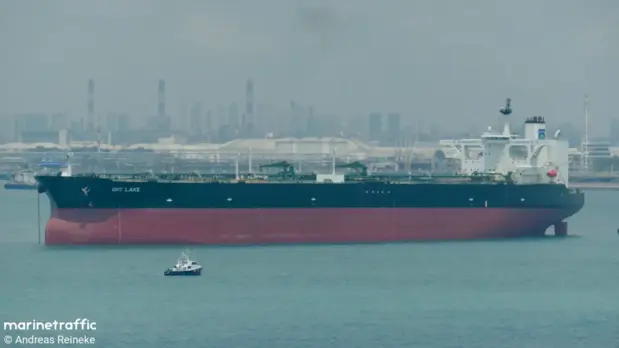
According to United Against Nuclear Iran, the vessel was involved in the transportation of sanctioned Iranian oil and switched to the transportation of sanctioned russian oil.
The Lauren II transports crude oil loaded by other tankers from ship to ship from the russian port of Primorsk in the Baltic Sea. In particular, the Lauren II was tracked while loading a cargo of crude oil by means of a ship-to-ship transfer from the tanker Zhen I (IMO 9255880).
The VLCC tanker was purchased from DHT Tankers and is affiliated with an anonymous Chinese buyer who spent about $376 million to acquire a group of 13 tankers for the high-risk transportation of russian-origin crude oil in the Atlantic Ocean. These 13 tankers include five Aframax vessels, seven very large crude oil carriers and one Suezmax vessel. According to Lloyd's List Intelligence, these vessels were purchased by an anonymous buyer through 20 separate but interconnected single-ship offshore companies from Hong Kong and China.
Subsequently, all but one of the tankers were engaged in transshipment of cargoes in the established high-risk transshipment hub for russian crude oil for consolidation of cargoes in the area 860 nautical miles west of Portugal, in international waters. The registered owners, commercial managers, and ISM manager are characterized by an almost identical registration address in Dalian (PRC), and the same two addresses in Hong Kong.
This group of tankers is considered to be the center of a fully operational mid-Atlantic transshipment hub for russian crude oil to China.
Logistics STS hubs allow to conceal the ownership and origin of cargo. In addition to the Mid-Atlantic hub, transshipment centers include areas near Kalamata, Greece, Malta, Ceuta, and the Caucasus, where STS operations for russian crude oil have been established.
The tanker, believed to be part of the shadow fleet, is affiliated with SUNNE CO LIMITED, which was sanctioned by USA on January 10, 2025 for its activities in the energy sector of the russian federation.
On January 10, 2025, USA imposed sanctions on the vessel as a property in which SUNNE CO LIMITED has an interest.
Since September 12, 2025, the United Kingdom has imposed sanctions on the vessel.
In November 2025, Canada imposed sanctions on the vessel.