


Encolpion cross
ID:
5716
Updated:
30.06.2026
Name:
Encolpion cross
Author:
Original name:
The country of the work of art:
Date:
Х–ХI century
Type:
Metal products
Technique of implementation:
Materials:
Dimensions:
8,5x5,4 sm
Special labels, markings, signatures:
ГМЗ ХТ. КП-18648
Location of special signs:
Description:
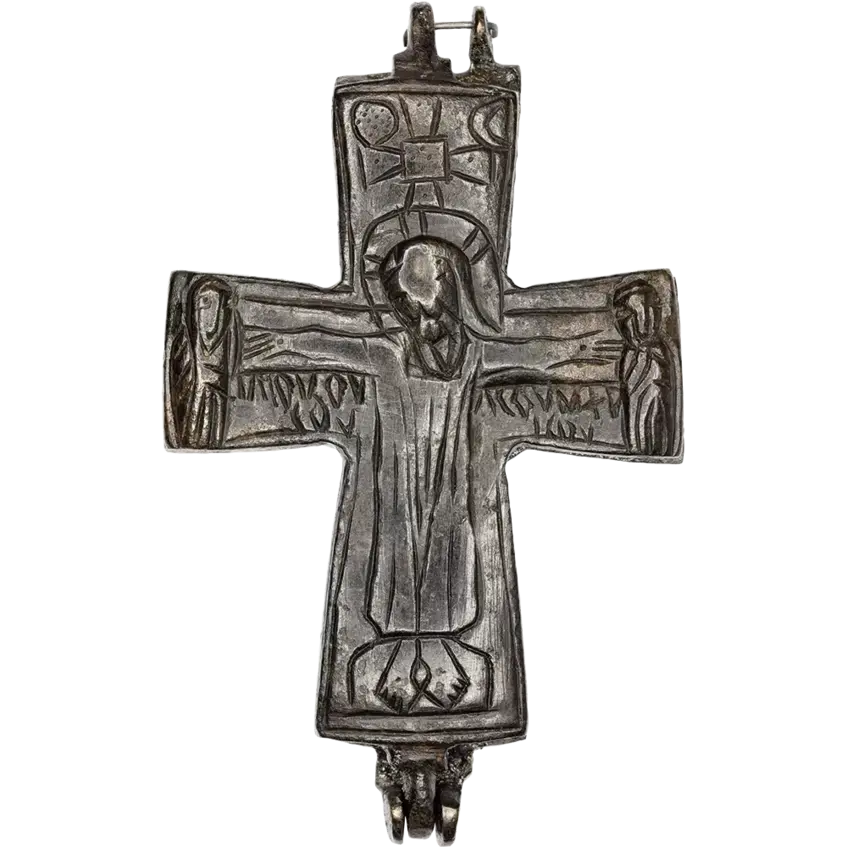
An enkolpion with straight, slightly flaring ends. In the center of the front panel is a depiction of Christ on the cross within a colobion, flanked by life-size figures of the future Mother of God and John the Theologian. Christ is depicted with a cross-shaped nimbus, a beard, and long hair; his head, lowered to his chest, is tilted toward his right shoulder. Above the Crucifixion is a cross with a square central crossbar; above that are the sun and the moon; beneath Christ’s hands are Greek inscriptions: "This is your son" / "This is your mother." Depictions of future generations. In the center of the reversible panel is a full-length depiction of the Virgin Mary Orans; at the ends of the cross’s arms are round medallions with bust portraits of the Evangelists, accompanied by explanatory Greek letters: at the top—Matthew (M), at the bottom—Mark (M), on the right—John (I), on the left—Luke (L); beneath the Virgin’s hands are the Greek letters: MP ѲV—"Mother of God." The figures are rendered in relief; the cross, astral symbols, and inscriptions are engraved. The central panel and part of the upper loop of the reverse side are missing.
Circumstances:
Stolen from the Tavrian Chersonese National Reserve to the territory of the russian federation under the cover of a temporary exhibition
Provide additional information
Details of theft
Year of the incident:
2023
Place of the incident:
National Reserve "Chersonese Tauride"
Coordinates (Lat, Lon):
44.61116682715866, 33.49212532954141
Place of last known stay:
Novgorod State United Museum-Reserve
Links
Archive links
Description of the incident location
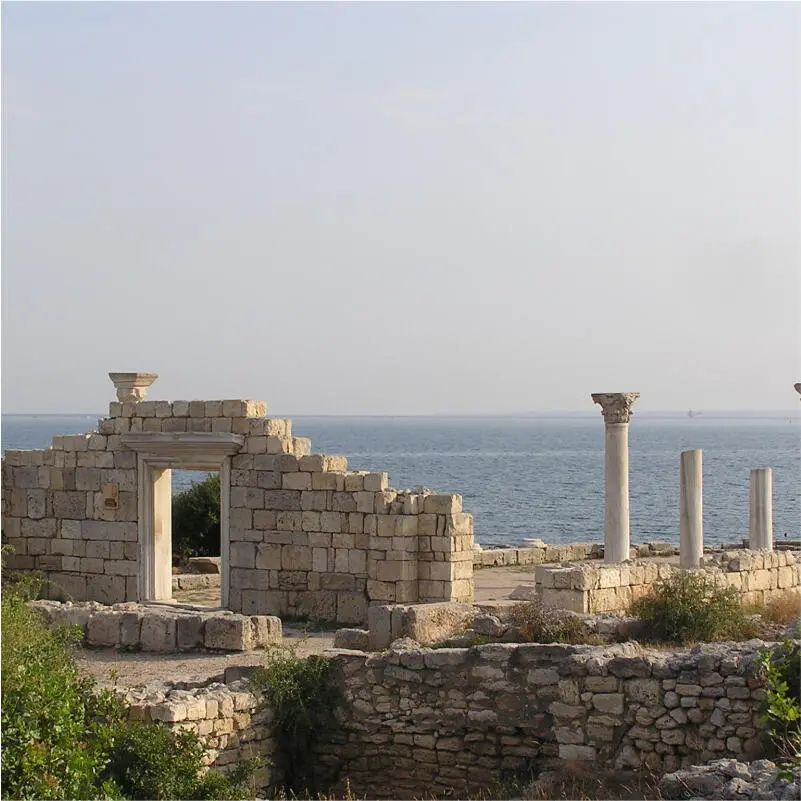
The museum called the "Warehouse of Local Antiquities" was first established in Chersonese in 1892, and since then it has been very popular among the general public. Initially, the institution was located on the shore of the Quarantine Bay, and the St. Volodymyr Monastery was located on the site of the ancient settlement. Chersonese State Historical and Archaeological Reserve with several branches, including: "Chembalo Fortress", "Kalamita Fortress" and the "Heracleian Clerics" department was established by a resolution of the Council of Ministers of the Ukrainian SSR on 31.01.1978 on the basis of immovable monuments of the cultural heritage of ancient and medieval Chersonesos and the Historical and Archaeological Museum. Since 1994, it has been state property of Ukraine and is subordinated to the Ministry of Culture of Ukraine. The museum's exposition in two buildings corresponds to two historical epochs: ancient and medieval. before the occupation of Russia in 2014, the museum's collection included more than 200 thousand exhibits, many of which are unique. The main object of the tour is the Chersonesos settlement itself - an open-air museum.
After the occupation of the peninsula, persons controlled by the russian federation regularly carry out illegal construction and reconstruction on the territory of the site. In addition, the russian federation exports cultural values and finds from the Tauric Chersonese National Reserve. In particular, a collection of artifacts from the Byzantine period was transported to Veliky Novgorod (Russian Federation) under the guise of an exhibition of federal museums called "Gold of Byzantium" dedicated to the 570th anniversary of the fall of the empire.
After the occupation of the peninsula, persons controlled by the russian federation regularly carry out illegal construction and reconstruction on the territory of the site. In addition, the russian federation exports cultural values and finds from the Tauric Chersonese National Reserve. In particular, a collection of artifacts from the Byzantine period was transported to Veliky Novgorod (Russian Federation) under the guise of an exhibition of federal museums called "Gold of Byzantium" dedicated to the 570th anniversary of the fall of the empire.
Provide additional information
