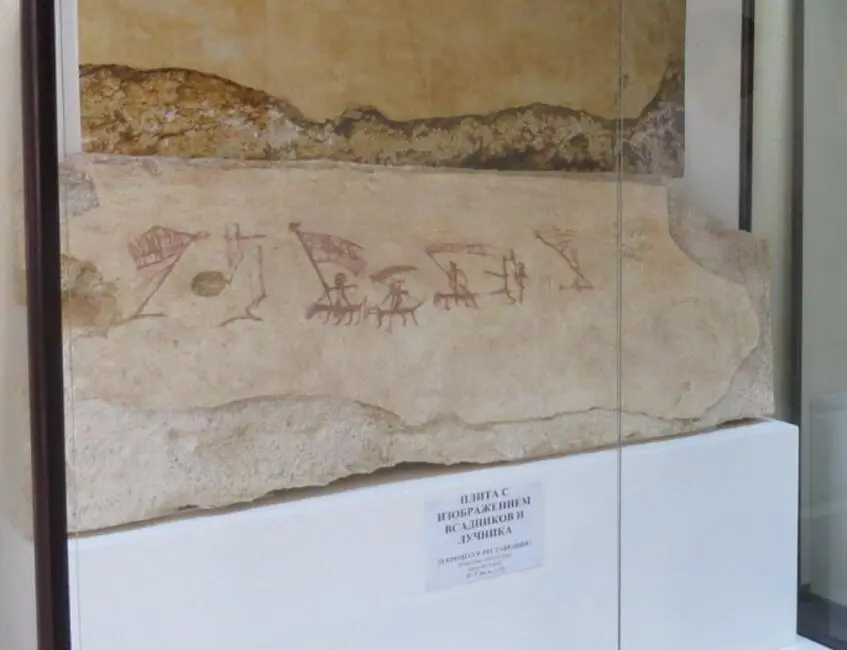
Plate with images of horsemen and archers
ID:
5599
Updated:
16.03.2026
Name:
Plate with images of horsemen and archers
Author:
Original name:
The country of the work of art:
Date:
IV-V century
Type:
Sculpture
Technique of implementation:
Materials:
Dimensions:
Special labels, markings, signatures:
Location of special signs:
Description:
It depicts a solar sign in the form of a circle with intersecting "rays" inside, applied in charcoal, and images of archers made in ochre. A small figure of an archer is located in the lower left corner of the slab: the linear outlines of a large curved bow with a taut string and the warrior's hands are marked with thin broken lines. Two archers are depicted in the lower right part of the slab. A layer of plaster with the described scene covers two stone squares in a continuous layer.
Circumstances:
Аppropriated by representatives of the russian federation during illegal excavations of cultural heritage sites of Ukraine
Provide additional information
Details of theft
Year of the incident:
2017
Place of the incident:
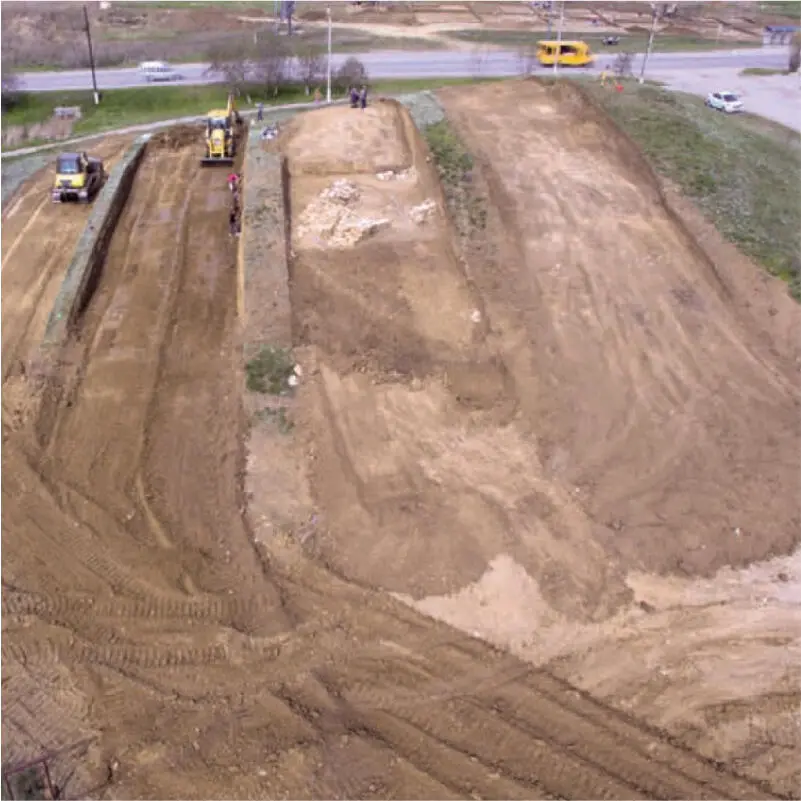
Monument of archeology "Hospital Mound"
Coordinates (Lat, Lon):
45.325132, 36.450248
Place of last known stay:
Monument of archeology "Hospital Mound"
Links
Archive links
Description of the incident location
The Hospital Mound (4th century BC) is a site of archaeological heritage in Ukraine and is one of the most famous mounds in the European and Asian Bosporus. According to the decision of the Crimean Regional Executive Committee No. 362 of June 21, 1983, the mound is a monument of local importance in Ukraine. The Hospital Mound is the largest in a chain of mounds that stretch across the top of the watershed above the Dzhardzhava River valley to the west of the Cement Slobodka residential area in Kerch. The illegal excavations of the Hospital mound lasted from March to August 2017. During the work, members of the New Construction Expedition of the Institute of Archeology of the russian Academy of Sciences discovered and looted a crypt dating back to the late IV century BC and several burials, one of which belonged to a soldier of the Ancient Roman period. As a result of the excavations, a significant collection of valuables, parts of the funeral ritual of the Bosporan nobility, and a medieval graffiti were found and removed from the burial structure of the mound, the central dromos.
Provide additional information