


Andrew the Apostle / Andriy Pеrshozvanyy
ID:
5172
Updated:
04.04.2025
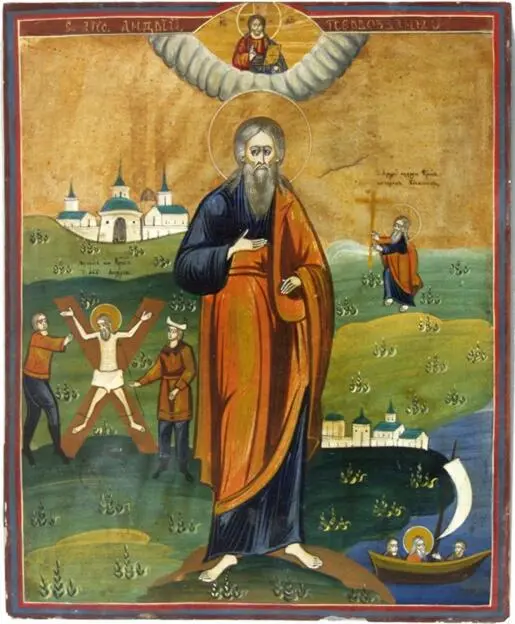
Name:
Andrew the Apostle / Andriy Pеrshozvanyy
Author:
Unknown artist
Original name:
The country of the work of art:
Date:
The second half of the 19th century.
Type:
Ікона
Technique of implementation:
Painting, iconography
Materials:
Wood, oil
Dimensions:
37x38,8 sm
Special labels, markings, signatures:
Ж – 1623, КП – 7036
Location of special signs:
On the back on the tree
Description:
Against the background of a conventionally interpreted multifaceted hilly landscape is a straightforward image of the Apostle Andrew the First-Called standing on a hill. He is in full-length. The face is ascetic and stern. His hair and wedge-shaped long beard are gray. The gaze of the black eyes is directed to the left. The right arm, bent at the elbow, is raised to chest level. The left hand, also bent at the elbow, is pressed to the left side. He is barefoot. Dressed in a dark blue chiton and an orange hymen. Around his head is a round golden halo. The life of the saint is chronologically interpreted in different ways from bottom to top and from right to left. In the lower right corner, against a background of blue water, is a full-length image of the saint with his right side turned ¾ to the right, sitting in a boat with white sails. To the left and right of him, facing him, are two young men (referring to the journey of St. Andrew up the Dnipro). A little higher is an image of a religious building (church, monastery) with white walls, green roofs, and a dome. On the right, slightly above the center, is St. Andrew in a ¾ turn to the left. He is full-length, holding a large yellow cross. Above him is a small, hard-to-read inscription in Church Slavonic (St. Andrew erects a cross on the Kyivan Mountains). Above, to the left of the central image of the saint, is a religious building (church, monastery) with white walls and green roofs and a dome. To the left of the center is a depiction of the saint tied to an X-shaped cross, with two young soldiers to his left and right. The one on the right holds a spear in his right hand. Above the cross is a small inscription in Church Slavonic (the torment on the cross of St. Andrew). The planar generalized image of the hills is given in dark and light green tones with yellow lettering. The light-air space is treated with gilding. Above, above a white cloud, is a girdled Jesus in a red chiton and blue hymen. He blesses with his right hand and holds the Gospel with his left. There is also an inscription in gold. The image is bordered from the very narrow margins by a blue and red outline. Small chips at the edges, scuffs. Traces of restoration. Top right: cracking of the levkas and paint layer. On the reverse, there are losses of wood texture in the corners, with their treatment by the owner before the icon was transferred to the museum (grinding, painting with a green substance).
Circumstances:
It was taken out of the Kherson Art Museum by representatives of the russian federation
Provide additional information
Details of theft
Year of the incident:
2022
Place of the incident:
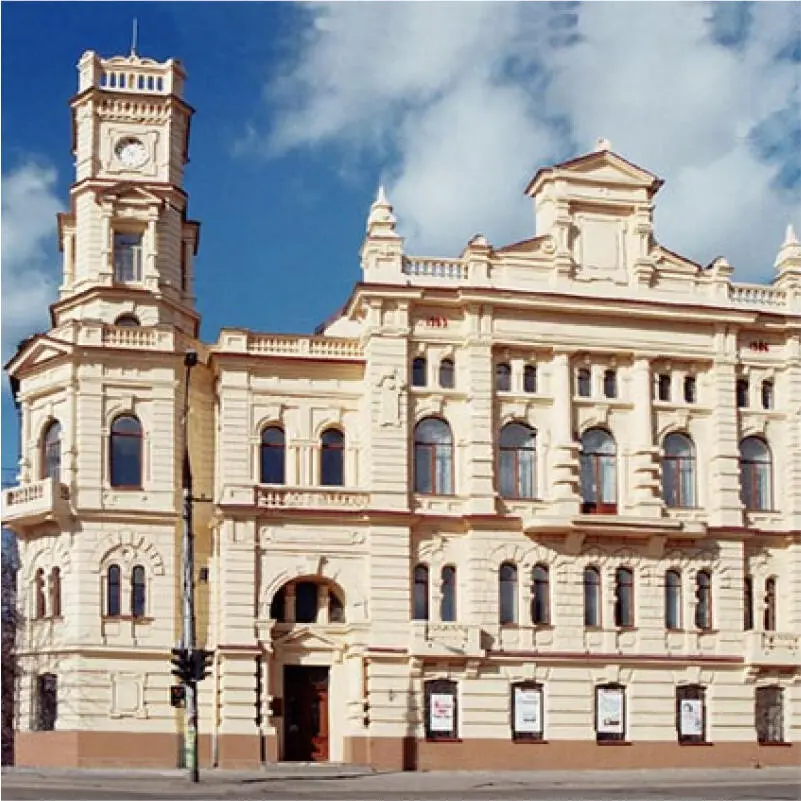
The Oleksii Shovkunenko Kherson Regional Art Museum
Coordinates (Lat, Lon):
46.62979067231111, 32.609546919505945
Place of last known stay:
Links
Archive links
Description of the incident location
It was opened on May 27, 1978, in the former City Hall building, an architectural monument of the early 20th century. As of 2022 (before the robbery), the museum's collection included more than 13 thousand works of art and was one of the most interesting museum collections in Ukraine. It includes works of Ukrainian and foreign painting, graphics, sculpture, and decorative and applied arts. From October 31 to November 4, 2022, the Kherson Art Museum was looted by the russian occupiers, and more than 10,000 of its most valuable exhibits were stolen. The cargo was sent to Crimea, and the works (all or part of them) ended up in the Simferopol Central Museum of Tavrida. It is unknown whether everything is still there.
Provide additional information
