


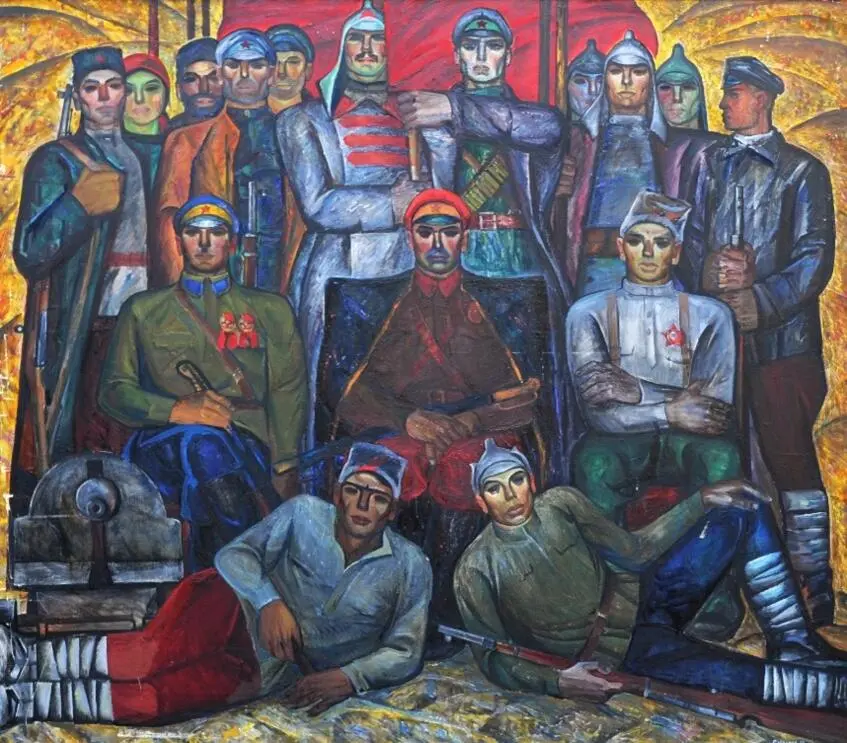
Winners / Peremozhtsi
ID:
5161
Updated:
02.04.2025
Name:
Winners / Peremozhtsi
Author:
Ivan Stepanov
Original name:
The country of the work of art:
Date:
1968
Type:
Painting
Technique of implementation:
Painting, multi-figure composition
Materials:
Canvas, oil
Dimensions:
175x150 sm
Special labels, markings, signatures:
Ж – 1601, КП – 6769
Location of special signs:
On the back on canvas or on a stretcher
Description:
Multi-figure three-row composition of a group of Red Army soldiers against the background of a red flag (center) and hilly terrain (right and left). The image is from the front only. Bottom row: two Red Army soldiers lying on the ground (the surface is uneven). Pictured on the left: resting on the left arm bent at the elbow, with the body turned to the left. The right hand, bent at the elbow, rests on the right thigh. The legs are tightly clenched. The interpretation of the face is generalized. He is dressed in a gray shirt with an unbuttoned collar and red pants. On his feet are boots, from which windings are wrapped almost to the knee. On his head is a kubanka. The one on the right is leaning on his right arm bent at the elbow, his body is turned to the right. The right hand holds a rifle lying next to him. He is dressed in a green leotard, blue pants (leggings). On his feet: wraps, boots. On his head: a bouillabaisse. The face is interpreted in a generalized way. Middle row (from left to right): a man sits near a machine gun (command staff) in a green uniform with blue patches on the collar, a brown portmanteau. On his head is a blue military cap with a red star. On his chest (left) are two Orders of the Red Banner. The right half-bent leg is thrown over the left. The left hand is lowered down; the right, bent at the elbow, holds a saber lowered down. The face is interpreted in a generalized way. In the center: a man is sitting in a brown leotard, tied with a belt. On his shoulders is a black burka. On his head is a red cap with a red star on a yellow brim. The right hand, bent at the elbow, holds a black saber. On his chest is an order. The face is interpreted in a generalized way. Seated on the right: a young man in a gray gymnastics jacket, tied with a belt, green pants. He wears a gray kubanka on his head. On his chest is the Order of the Red Banner. His arms are bent at the elbows and folded over each other. Third row: a group of Red Army soldiers, including a young woman wearing a red scarf. In the center is a Red Army soldier in a gray overcoat and a Budynivka jacket with a red star. Next to him, on the right, is a Red Army soldier in a green uniform and a portmanteau; he is wearing a cap with a red star on the brim. There is a machine gun ribbon across his chest.
On the back, on the stretcher, there are three labels on top. The Directorate of Exhibitions of the USSR and one label of the art salon for the export of the Eastern USSR. Top left on the canvas (in the corner): brown paint in block letters author's inscription: STEPANOV I.F. (1937) d. Chisinau MSSR "Winners" 1968, h.m. 175х155. On the stretcher in the lower left corner is the old inv.no. GPKG Zh-49 KP-52
Numerous pinpoints with loss of paint layer. Scratches to the right of the center. Partial cracking of the paint layer.
On the back, on the stretcher, there are three labels on top. The Directorate of Exhibitions of the USSR and one label of the art salon for the export of the Eastern USSR. Top left on the canvas (in the corner): brown paint in block letters author's inscription: STEPANOV I.F. (1937) d. Chisinau MSSR "Winners" 1968, h.m. 175х155. On the stretcher in the lower left corner is the old inv.no. GPKG Zh-49 KP-52
Numerous pinpoints with loss of paint layer. Scratches to the right of the center. Partial cracking of the paint layer.
Circumstances:
It was taken out of the Kherson Art Museum by representatives of the russian federation
Provide additional information
Details of theft
Year of the incident:
2022
Place of the incident:
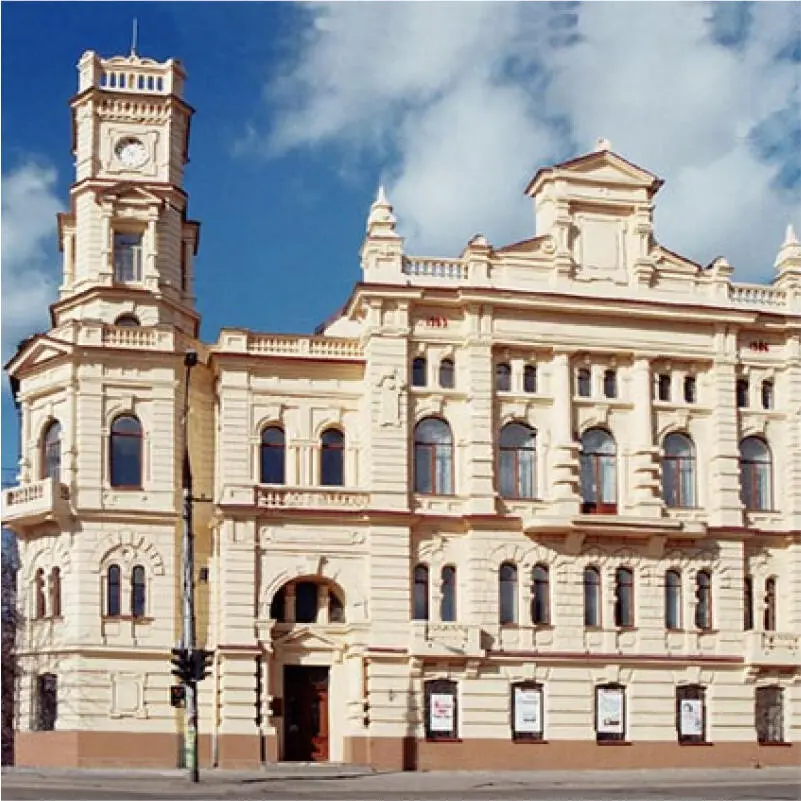
The Oleksii Shovkunenko Kherson Regional Art Museum
Coordinates (Lat, Lon):
46.62979067231111, 32.609546919505945
Place of last known stay:
Links
Archive links
Description of the incident location
It was opened on May 27, 1978, in the former City Hall building, an architectural monument of the early 20th century. As of 2022 (before the robbery), the museum's collection included more than 13 thousand works of art and was one of the most interesting museum collections in Ukraine. It includes works of Ukrainian and foreign painting, graphics, sculpture, and decorative and applied arts. From October 31 to November 4, 2022, the Kherson Art Museum was looted by the russian occupiers, and more than 10,000 of its most valuable exhibits were stolen. The cargo was sent to Crimea, and the works (all or part of them) ended up in the Simferopol Central Museum of Tavrida. It is unknown whether everything is still there.
Provide additional information
