


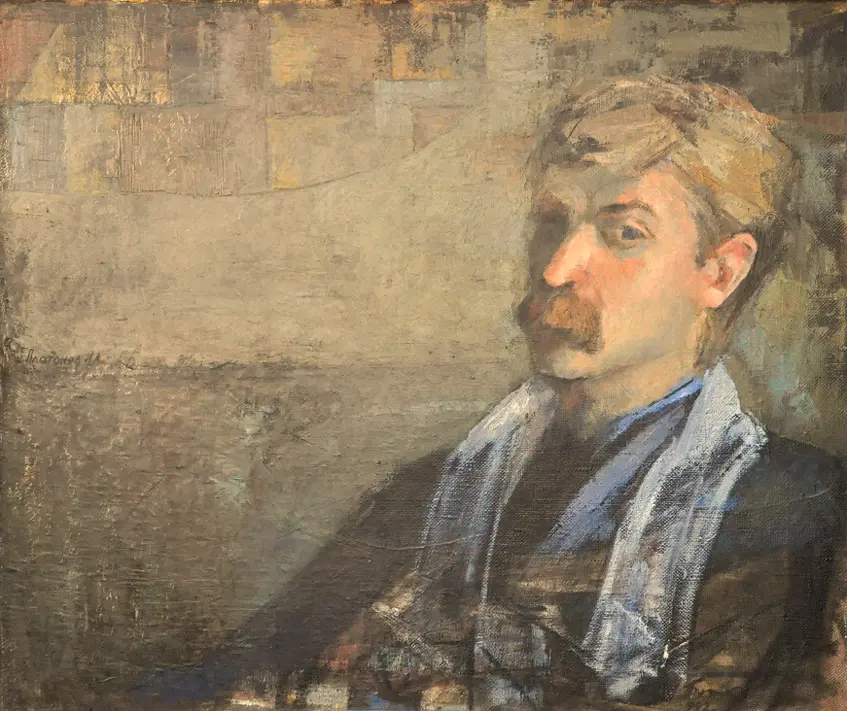
Portrait of Platonov / Portret Platonova
ID:
5106
Updated:
31.03.2025
Name:
Portrait of Platonov / Portret Platonova
Author:
Gennadiy Puzyk
Original name:
The country of the work of art:
Date:
1992
Type:
Painting
Technique of implementation:
Painting, portrait
Materials:
Canvas, oil
Dimensions:
70,5x60 sm
Special labels, markings, signatures:
Ж – 1378, КП – 6155
Location of special signs:
On the back on canvas or on a stretcher
Description:
In the right part there is a full-length image of a blond young man, in 3/4 of a turn to the left. Dark blue clothes and a light scarf are given in generalized terms. The face is narrow with a thin straight nose and expressive eyes. He has a thick mustache. The left side of the face is illuminated, the right side is in shadow. The background on the left is divided horizontally into two parts. The lower one is dark, green-brown, and the upper one is olive. At the top is a semi-oval plane filled with yellow, brown, blue quadrangles and triangles. On the back - Top left: Portrait of Platonov I.A. 1992. Signed by the author and dated 1964.
Circumstances:
It was taken out of the Kherson Art Museum by representatives of the russian federation
Provide additional information
Details of theft
Year of the incident:
2022
Place of the incident:
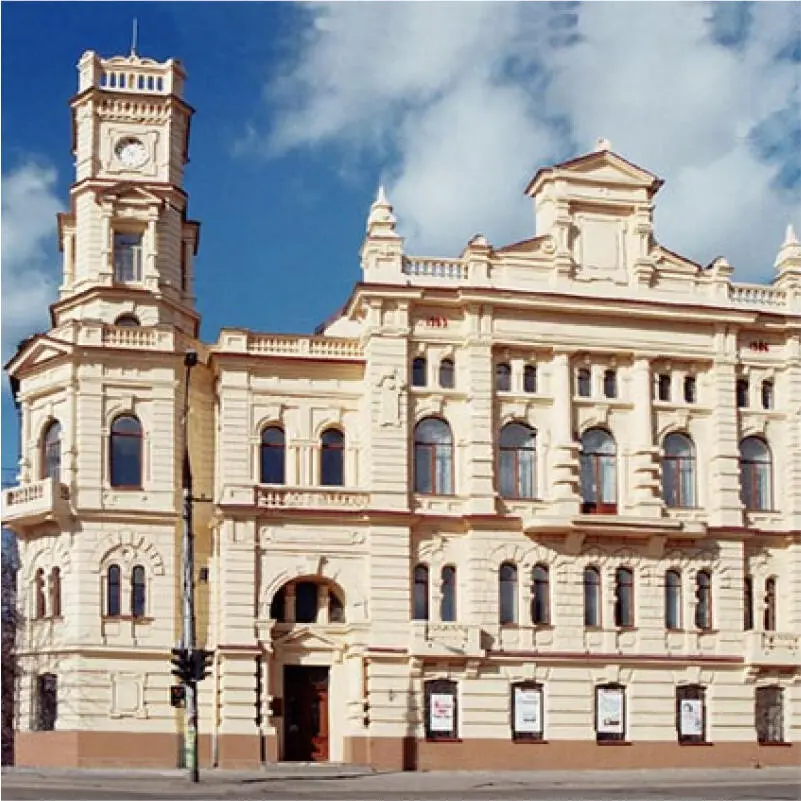
The Oleksii Shovkunenko Kherson Regional Art Museum
Coordinates (Lat, Lon):
46.62979067231111, 32.609546919505945
Place of last known stay:
Links
Archive links
Description of the incident location
It was opened on May 27, 1978, in the former City Hall building, an architectural monument of the early 20th century. As of 2022 (before the robbery), the museum's collection included more than 13 thousand works of art and was one of the most interesting museum collections in Ukraine. It includes works of Ukrainian and foreign painting, graphics, sculpture, and decorative and applied arts. From October 31 to November 4, 2022, the Kherson Art Museum was looted by the russian occupiers, and more than 10,000 of its most valuable exhibits were stolen. The cargo was sent to Crimea, and the works (all or part of them) ended up in the Simferopol Central Museum of Tavrida. It is unknown whether everything is still there.
Provide additional information
