


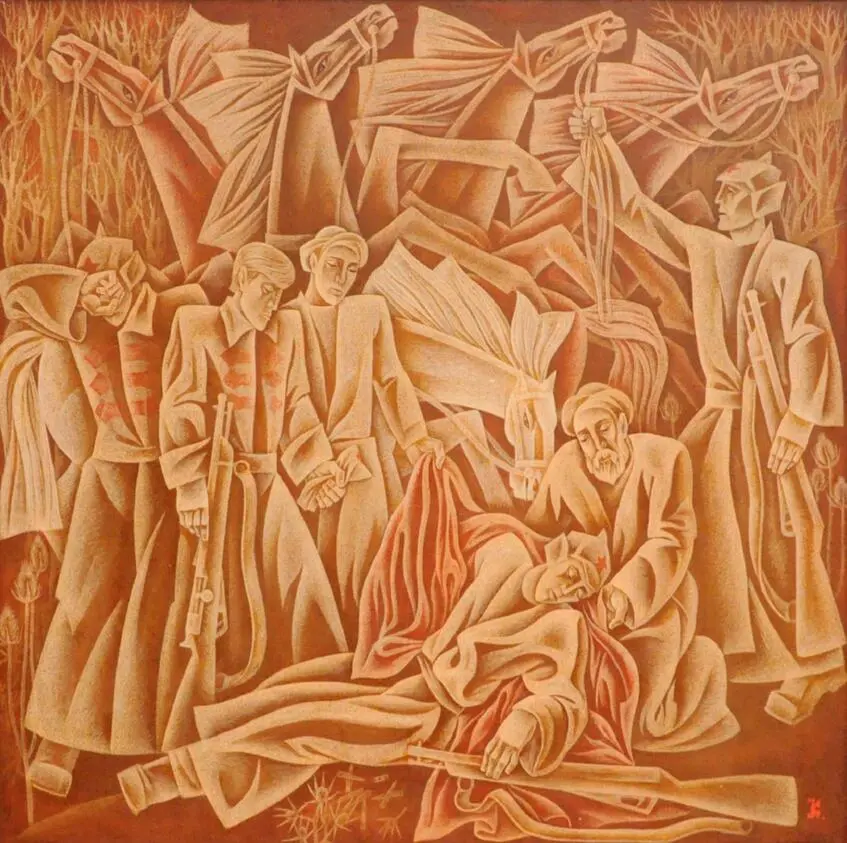
Fallen flag bearer (Komsomol in the civil war) / Zahyblyi praporonosets zahyblyi praporonosets (komsomol u hromadiаnskii viini)
ID:
4279
Updated:
22.01.2025
Name:
Fallen flag bearer (Komsomol in the civil war) / Zahyblyi praporonosets zahyblyi praporonosets (komsomol u hromadiаnskii viini)
Author:
Sukhrob Kurbanov
Original name:
The country of the work of art:
Date:
1978
Type:
Painting
Technique of implementation:
Painting, plot
Materials:
Canvas, oil
Dimensions:
134x139 sm
Special labels, markings, signatures:
Ж – 998, КП – 3339
Location of special signs:
On the back on canvas or on a stretcher
Description:
Multi-figure single-plane composition. In the center - a Red Army soldier who has fallen on the flag, in a Budyonny coat. He lowered his left hand to his rifle. The image is given in a 3/4 turn to the right. The Red Army soldier is supported by an old man standing on his knees in national Tajik clothing. On the right, a Red Army soldier is depicted in left profile, holding a rifle in his lowered left hand, and the reins of two horses in his raised right hand. On the left - a group of three people; in a 3/4 turn to the right, a young man in national Tajik clothing who has raised the fabric of the flag; the Red Army soldier is a figure in full face, his head is in right profile, with his arms lowered, the fingers of his left hand on the barrel of a rifle placed on the butt, in his right - a Budyonny coat clenched in a fist. Near the left edge - in the front view of a Red Army soldier with a bowed head, covering his face with the fist of his right hand. In the upper part of the composition - above the people - four horses standing on their hind legs (the far left one is turned to the left, the others to the right). Behind the group of people and horses - a bunch of trees with bare branches.
At the bottom right - the author's monogram: "K." On the stretcher, in the middle from above in blue felt-tip pen: "13-3 K-45", below: "S9"; on the vertical crossbar of the stretcher in black pencil: "№6930 DV SKh USSR"; in black felt-tip pen: "to the exhibition under the contract "60 years of the Komsomol""; on the canvas on the left in brown felt-tip pen: "Kurbanov S.U.1946 139x134.5 in. temp. 1978". In blue paste: "Komsomol in the Civil War. "Fallen Standard Bearer""; on the canvas on the right in black paste: "Kurbanov S.U.1946 Komsomol in the Civil War. "Fallen Standard Bearer" 139x134.5 in. tempera. 1978".
Condition: Satisfactory, slight soiling of the canvas.
At the bottom right - the author's monogram: "K." On the stretcher, in the middle from above in blue felt-tip pen: "13-3 K-45", below: "S9"; on the vertical crossbar of the stretcher in black pencil: "№6930 DV SKh USSR"; in black felt-tip pen: "to the exhibition under the contract "60 years of the Komsomol""; on the canvas on the left in brown felt-tip pen: "Kurbanov S.U.1946 139x134.5 in. temp. 1978". In blue paste: "Komsomol in the Civil War. "Fallen Standard Bearer""; on the canvas on the right in black paste: "Kurbanov S.U.1946 Komsomol in the Civil War. "Fallen Standard Bearer" 139x134.5 in. tempera. 1978".
Condition: Satisfactory, slight soiling of the canvas.
Circumstances:
It was taken out of the Kherson Art Museum by representatives of the russian federation
Provide additional information
Details of theft
Year of the incident:
2022
Place of the incident:
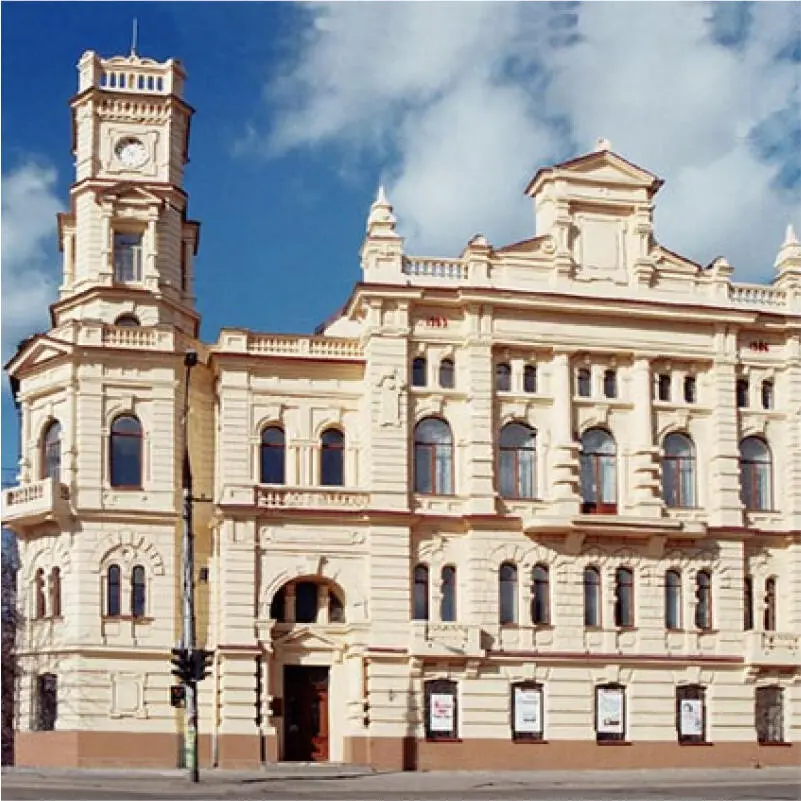
The Oleksii Shovkunenko Kherson Regional Art Museum
Coordinates (Lat, Lon):
46.62979067231111, 32.609546919505945
Place of last known stay:
Links
Archive links
Description of the incident location
It was opened on May 27, 1978, in the former City Hall building, an architectural monument of the early 20th century. As of 2022 (before the robbery), the museum's collection included more than 13 thousand works of art and was one of the most interesting museum collections in Ukraine. It includes works of Ukrainian and foreign painting, graphics, sculpture, and decorative and applied arts. From October 31 to November 4, 2022, the Kherson Art Museum was looted by the russian occupiers, and more than 10,000 of its most valuable exhibits were stolen. The cargo was sent to Crimea, and the works (all or part of them) ended up in the Simferopol Central Museum of Tavrida. It is unknown whether everything is still there.
Provide additional information
