


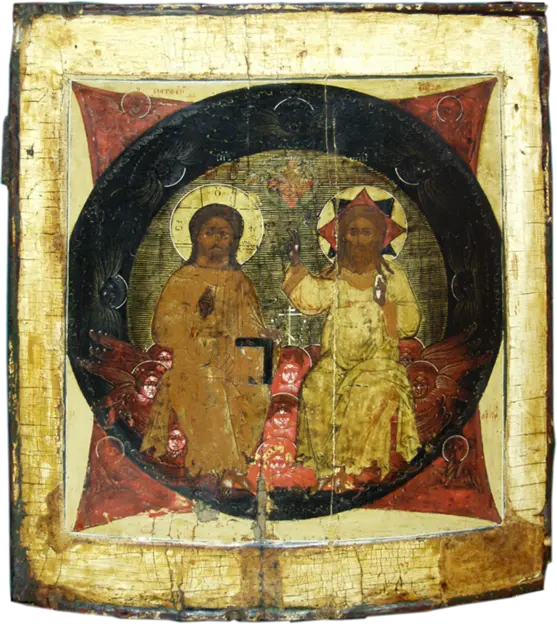
The Triune Godhead / Tryipostasne bozhestvo (ikona)
ID:
4251
Updated:
22.01.2025
Name:
The Triune Godhead / Tryipostasne bozhestvo (ikona)
Author:
Unknown artist
Original name:
The country of the work of art:
Date:
mid-XIX century
Type:
Ікона
Technique of implementation:
Painting, iconography
Materials:
Wood, tempera, levkas, drag
Dimensions:
29x33 sm
Special labels, markings, signatures:
Ж – 845, КП – 2955
Location of special signs:
On the back of the board
Description:
In a black circle with the heads of seraphim around the edge on the right is God the Father in a light brown robe with a halo in the form of eight-pointed stars, with a blessing gesture with his left hand. On the left is God the Son in a brown robe. Above in the centre is a dove. Below are the heads of cherubs and seraphim. In the red triangles touching the circle are four symbolic images of the evangelists. The lower bar is missing. Vertical crack of the board with a pattern of paint layer and soil. Scratches along the edges of the board. The base board is glued, the paint layer and primer are locally reinforced, and surface contaminants are removed. Restoration primer was applied. Toning. Varnishing.
Circumstances:
It was taken out of the Kherson Art Museum by representatives of the russian federation
Provide additional information
Details of theft
Year of the incident:
2022
Place of the incident:
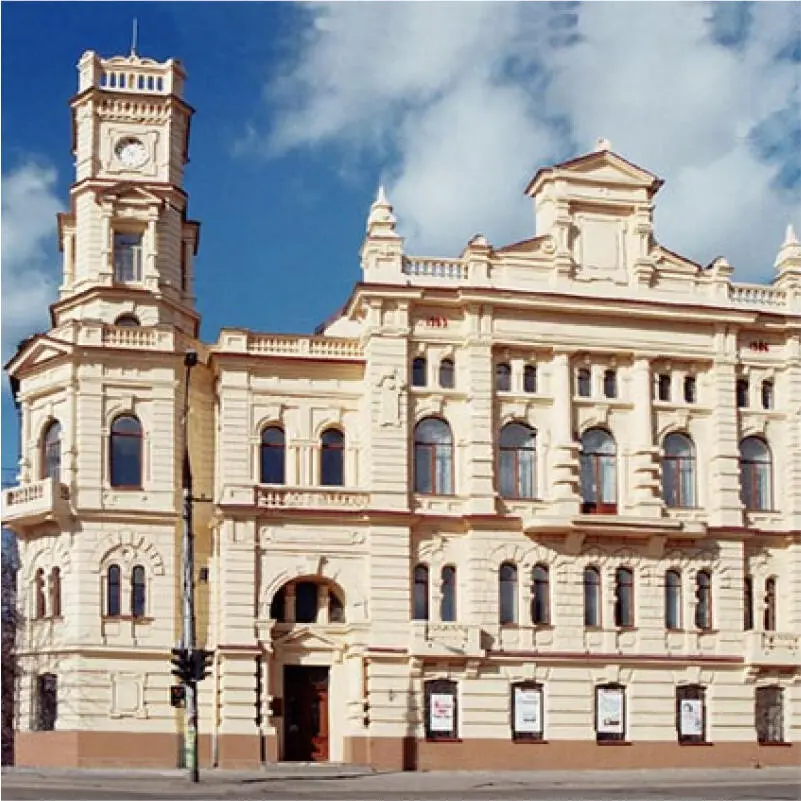
The Oleksii Shovkunenko Kherson Regional Art Museum
Coordinates (Lat, Lon):
46.62979067231111, 32.609546919505945
Place of last known stay:
Links
Archive links
Description of the incident location
It was opened on May 27, 1978, in the former City Hall building, an architectural monument of the early 20th century. As of 2022 (before the robbery), the museum's collection included more than 13 thousand works of art and was one of the most interesting museum collections in Ukraine. It includes works of Ukrainian and foreign painting, graphics, sculpture, and decorative and applied arts. From October 31 to November 4, 2022, the Kherson Art Museum was looted by the russian occupiers, and more than 10,000 of its most valuable exhibits were stolen. The cargo was sent to Crimea, and the works (all or part of them) ended up in the Simferopol Central Museum of Tavrida. It is unknown whether everything is still there.
Provide additional information
